Our Research
Understanding Cancer Immune Evasion through Trogocytosis
Our laboratory investigates how cancer cells acquire immune regulatory molecules from T cells through a membrane-transfer process called trogocytosis — and how disrupting this mechanism can restore anti-tumor immunity.
What is Trogocytosis?
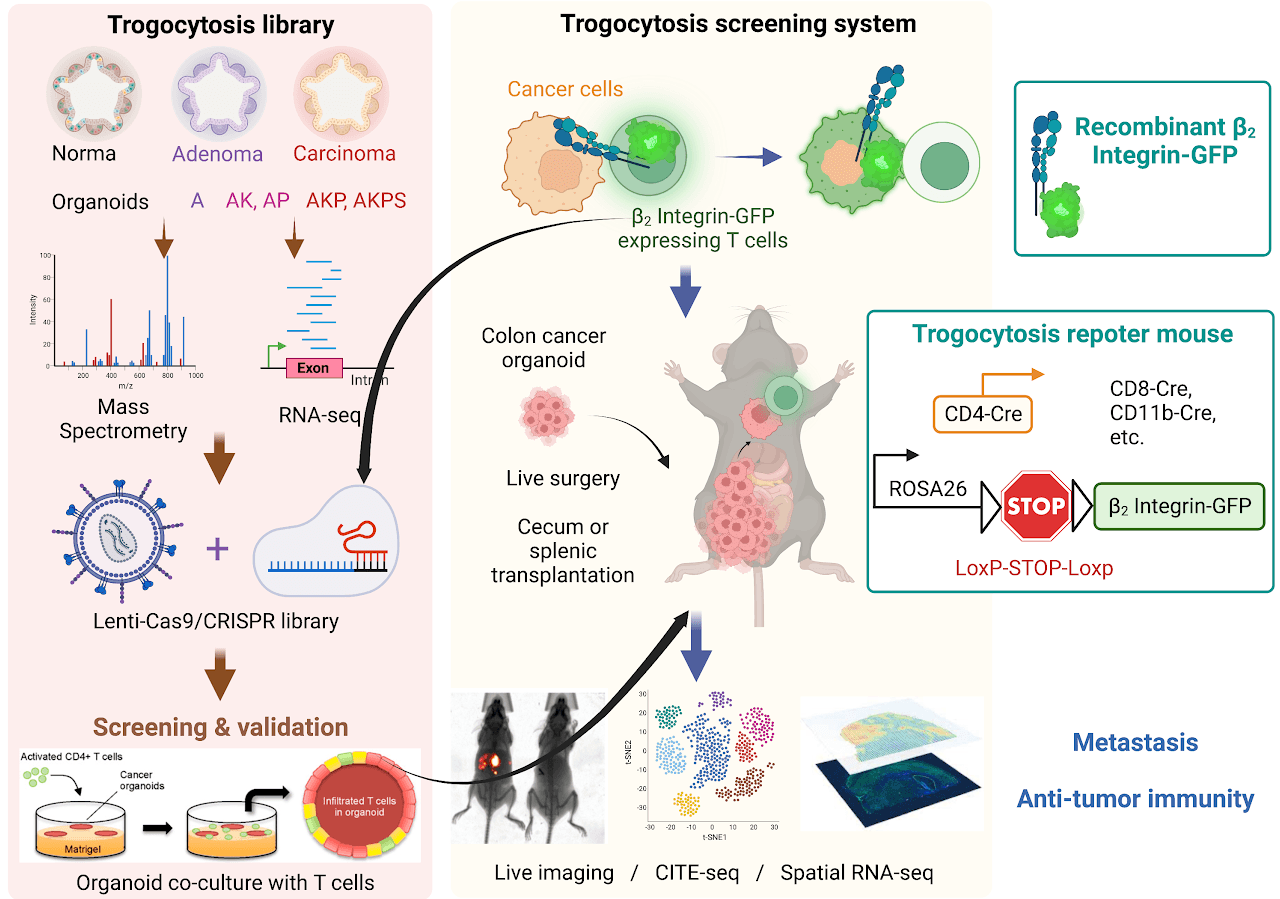
Trogocytosis is a process by which cancer cells physically extract fragments of membrane — including immune regulatory proteins — from tumor-infiltrating T cells during direct contact. By acquiring these molecules, cancer cells can masquerade as immune cells, suppressing anti-tumor responses and escaping immune surveillance.
Our landmark 2021 PNAS paper demonstrated that colon cancer cells acquire immune regulatory molecules from tumor-infiltrating lymphocytes by trogocytosis, opening a new avenue for therapeutic intervention.
Research Fields
Development of a Novel Platform for Evaluating T Cell–Mediated Anti-Tumor Immunity and Its Application to Organoid-Based Drug Screening
This study aims to develop a recombinant fluorescent protein–based system that employs a mechanism distinct from conventional T cell activity assays. This system will enable rapid quantitative evaluation of T cell–mediated anti-tumor activity in an organoid co-culture–based drug screening platform. The ultimate goal is to establish a co-culture drug screening system using patient-derived organoids and immune cells, thereby providing a method for assessing T cell activity that recapitulates the patient-specific tumor microenvironment.
Trogocytosis-Mediated CAR Transfer Activates CAR Signaling in B-Cell Lymphoma.
This study focuses on trogocytosis in CAR-T cell therapy, investigating how CAR molecules are transferred to tumor cells and subsequently activate signaling pathways. It aims to uncover functional changes in tumor cells and identify novel therapeutic targets beyond conventional mechanisms of CAR-T dysfunction.
Integrated Computational Analysis and In Vivo Validation of Trogocytosis-Associated Cellular States in Colon Cancer Using CITE-seq data
This study investigates the role of trogocytosis in shaping tumor–immune interactions in colon cancer through integrated single-cell transcriptomic analysis of patient samples. By characterizing trogocytosis-associated cellular states and their molecular signatures at single-cell resolution, we aim to uncover how intercellular membrane transfer influences immune cell identity and function within the tumor microenvironment. Key findings will be validated in mouse in vivo models to establish the functional relevance of trogocytosis in cancer progression and anti-tumor immunity.
Glucose Metabolism-mediated Anti-cancer Effect of Allulose in Colon Cancer
Allulose, a rare sugar, suppresses the growth of colorectal cancer by inhibiting HIF1α-driven metabolic reprogramming. Treatment with allulose downregulates GLUT1 and key glycolytic genes, disrupting the Warburg effect that cancer cells depend on for survival. These findings suggest allulose as a promising dietary intervention targeting cancer metabolism.
Development of Anti-Tumor Immune mRNA-LNP with Adjuvant Function via Lipid Composition Modification
This research aims to develop next-generation mRNA-LNP vaccines by modifying lipid composition to endow intrinsic adjuvant properties, building on the success of COVID-19 mRNA vaccines. While current platforms are highly effective against infectious diseases, we focus on enhancing TH1 anti-tumor immunity by promoting CD4+ T cell responses w/ CD8+ T cells through RIPK3 pathway. This approach seeks to expand mRNA vaccine applications into cancer immunotherapy.
Modeling of CRC liver metastasis
In this research, we develop a non-surgical, orthotopic colorectal cancer (CRC) model that enables spontaneous liver metastasis. Using organoid-based transplantation, we track primary tumor growth, circulating tumor cells (CTCs), and metastatic progression. This platform provides a clinically relevant system to study tumor–immune interactions and identify therapeutic targets.
Reduced CH25H Expression Defines a High Membrane Fluidity, Trogocytosis Active State in Colon Cancer Stem Cells
The following research focuses on cancer stem cells using spheroid models to better capture their functional states. I investigate how these cells interact with immune cells, particularly through trogocytosis-mediated membrane transfer. My work aims to understand the cellular mechanisms underlying these interactions.
Investigating the Impact of Environmental Pollutants (PM2.5 and Microplastics) on Immune Cell Senescence and Cancer Progression
The following research investigates how environmental pollutants — particularly PM2.5 and microplastics — induce T cell immunosenescence and accelerate cancer metastasis. Using in vitro and in vivo models combined with multiomics analysis, I aim to uncover the underlying mechanisms and develop a biodetection and mitigation platform for emerging environmental threats.
Graphene Oxide Based Fluorescence Probe Platform for Detecting Colorectal Cancer Biomarkers
The following research focuses on developing a blood-based liquid biopsy platform to detect tumor-derived nucleic acid biomarkers associated with colorectal cancer progression, metastasis, and recurrence. The goal of my research is to establish a fluorescence-based system using graphene oxide for the rapid and sensitive detection of colorectal cancer-derived RNA/DNA.
CD8⁺ T Cell Exhaustion in Tumor Immunity
This research investigates CD8⁺ T cell exhaustion in tumor immunity. Using an antigen-driven in vitro model, I examine changes in T cell function and exhaustion-associated phenotypes. This work aims to improve anti-tumor immune responses and advance immunotherapy strategies.
Functional characterization of PM2.5-induced T-cell immunosenescence
This study investigates how environmentally collected PM2.5 alters T-cell function and promotes senescence associated changes. Using murine splenocyte-based in vitro models, it analyzes functional and senescence related responses to better understand PM2.5 induced T cell immunosenescence.
Trogocytosis in Action
Live imaging analysis for 6 h
Cell trackers (undiffusable to adjacent cells) were used to stain T cells as follow
Cytosol: CMFDA (Green)
Membrane: DiD (Red)
Interested in Collaboration?
We welcome collaborations with academic institutions and industry partners. Contact us to discuss potential research partnerships.
Get in Touch